The European Telecommunications Standards Institute (ETSI) has published the first globally applicable cybersecurity standard for artificial intelligence systems, establishing baseline security requirements across the full AI lifecycle.
Wellington City Council and Fire and Emergency New Zealand (FENZ) have deployed intelligent document processing systems to meet new regulatory requirements, eliminating manual data entry for rates rebates and invoice processing.
Half of all organisations will implement zero-trust data governance by 2028 as AI-generated content floods information systems, according to Gartner predictions released this week.
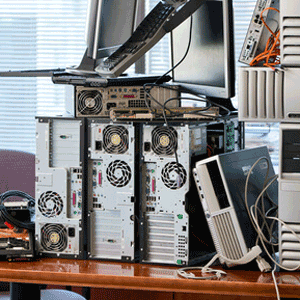
In today’s data-driven economy, organisations invest heavily in cybersecurity, compliance and digital transformation. Yet, one critical vulnerability continues to fly under the radar: the security risks associated with retired IT assets.
With 60 Australian organisations across six industry sectors being targeted in a nation-wide privacy compliance sweep in January, EzeScan’s says its new Document Repository Analyser (DRA) closes a major gap in compliance workflows by combining discovery and remediation in one platform
The NSW Food Authority has issued a tender for an artificial intelligence tool to automate the assessment of penalty notices, aiming to replace a manual process currently requiring a full-time employee earning $115,000 annually.
An audit of 4 out of 15 NSW Local Health Districts (LHDs) by the state’s Auditor-General found they failed to meet minimum cyber security requirements, leaving clinical systems vulnerable to attacks that could disrupt healthcare delivery.
Privacy team sizes have plummeted by more than one-third globally, with the median dropping from eight staff to five, according to ISACA's State of Privacy 2026 report released this week.
Only 17 per cent of Australian Government agencies disclose their use of automated decision-making (ADM) systems despite legal requirements to inform the public, according to a new report from the Office of the Australian Information Commissioner (OAIC).
Sixty Australian organisations face a critical compliance test in January 2026 when the Office of the Australian Information Commissioner conducts its first privacy compliance sweep, targeting entities across six sectors that collect personal information in person. Brisbane-based EzeScan has launched its Automated PII & PCI Discovery and Redaction Suite to address the compliance gap.
The European Telecommunications Standards Institute (ETSI) has published the first globally applicable cybersecurity standard for artificial intelligence systems, establishing baseline security requirements across the full AI lifecycle.
Wellington City Council and Fire and Emergency New Zealand (FENZ) have deployed intelligent document processing systems to meet new regulatory requirements, eliminating manual data entry for rates rebates and invoice processing.
Half of all organisations will implement zero-trust data governance by 2028 as AI-generated content floods information systems, according to Gartner predictions released this week.
In today’s data-driven economy, organisations invest heavily in cybersecurity, compliance and digital transformation. Yet, one critical vulnerability continues to fly under the radar: the security risks associated with retired IT assets.
With 60 Australian organisations across six industry sectors being targeted in a nation-wide privacy compliance sweep in January, EzeScan’s says its new Document Repository Analyser (DRA) closes a major gap in compliance workflows by combining discovery and remediation in one platform
The NSW Food Authority has issued a tender for an artificial intelligence tool to automate the assessment of penalty notices, aiming to replace a manual process currently requiring a full-time employee earning $115,000 annually.
An audit of 4 out of 15 NSW Local Health Districts (LHDs) by the state’s Auditor-General found they failed to meet minimum cyber security requirements, leaving clinical systems vulnerable to attacks that could disrupt healthcare delivery.
Privacy team sizes have plummeted by more than one-third globally, with the median dropping from eight staff to five, according to ISACA's State of Privacy 2026 report released this week.
Only 17 per cent of Australian Government agencies disclose their use of automated decision-making (ADM) systems despite legal requirements to inform the public, according to a new report from the Office of the Australian Information Commissioner (OAIC).
Sixty Australian organisations face a critical compliance test in January 2026 when the Office of the Australian Information Commissioner conducts its first privacy compliance sweep, targeting entities across six sectors that collect personal information in person. Brisbane-based EzeScan has launched its Automated PII & PCI Discovery and Redaction Suite to address the compliance gap.